Handshake AI Fellowship Review (2026): $919.99 Paid So Far, but Projects Come and Go
Some links here are referral links. If you sign up and do paid work, the platform may pay me; it costs you nothing. Full disclosure.
Handshake AI is legit, and its applications are among the easiest I’ve done in AI training. It has paid me $919.99 since June 2026. My first project paid $100/hr and dropped me after about a week. My current one pays $125/hr, and it’s paid me $540 in incentives while I wait for the client to start. Project pay is all over the place, though. I’ve also seen $10/hr plus $120 per approved task. My advice: apply, since it costs you almost nothing, then judge each project on its own terms before you take the work.
| Handshake AI Fellowship at a glance | My experience |
|---|---|
| Current pay model | Project-specific hourly or per-task pay |
| My project rates | $100/hr in June 2026; $125/hr on my current project |
| Initial application | Usually a short form; no AI interview in my experience |
| Work | Prompt writing, response evaluation, validation, and domain review |
| Best fit | Students, researchers, and people with a defensible specialty |
| Main downside | A high chance of being offboarded, plus time caps and per-task approval risk |
Is the Handshake AI Fellowship legit?
Yes. Handshake AI is part of Handshake, the career platform, so you’re not dealing with some anonymous data-labeling site. The Fellowship recruits students and experts for AI training and evaluation projects, and you see the rate before any work begins. It has paid me every time I’ve done paid work there, and my view here comes from going through the applications and those two projects myself.
What the work is
What you’ll do depends on the project and your background. Fellowship work can include:
- writing prompts or examples that test a model
- comparing and rating model responses
- checking factual accuracy and instruction-following
- validating completed tasks against a rubric
- judging domain-specific reasoning in your area of expertise
The last item is why education and work history matter so much here. A project grading advanced research or code needs people who can defend their judgment.
How much does Handshake AI pay?
I think Handshake has some of the highest- and lowest-paid roles in the industry. Some pay great: I’m on a $125/hr project now. Others pay horribly. I’ve also seen $10/hr plus $120 per approved task, and if a task isn’t approved, you don’t get the $120. How long each task takes decides what that offer is really worth. And before assuming the $10/hr covers every hour you work, find out whether it’s conditional too.
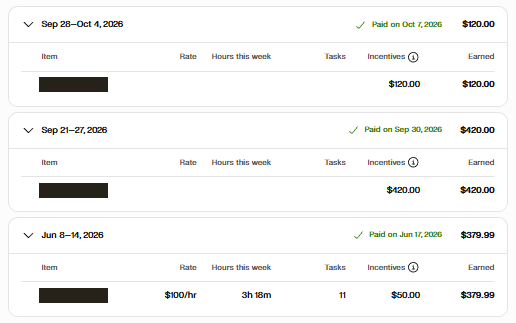
My first project picked me on June 10, 2026, at $100/hr. That week (June 8–14) I worked 3 hours 18 minutes on 11 tasks, and Handshake paid me $379.99 on June 17, including a $50 incentive. The next day I was removed from the project for “changing project needs.”
The $125/hr project hasn’t started yet. The client still hasn’t kicked it off, but it’s paid me $540 in incentives so far: $420 on September 30 and $120 on October 7, including a paid onboarding call and a paid trainer workshop. Next is the client’s screener, which pays $500 if I pass, and then the hourly work starts. If I pass this screener, I’ll have made about $1,000 before ever doing a task.
My recent payouts came through Stripe, a few days after each week ended.
Current pay model: read the terms before you start
When I checked Handshake’s earnings guidance on September 12, 2026, it said projects may pay hourly or per task. Hourly projects can set a maximum handling time. If a task runs past it, your paid time stops at the cap, and you still have to finish and successfully submit the task. The contractor agreement has the same rule. So the timer won’t protect your effective hourly rate.
Workers on r/joinhandshakeai have described long per-task assignments with slow reviews, and some weren’t sure their submitted work would be paid. Those are individual reports, and people with bad experiences post more than people with good ones. They’re still enough to make me careful with per-task work. Start with the threads on per-task risk and time caps, then the one on recent payment concerns.
Before accepting a project, I’d:
- Confirm whether pay is hourly or per task, and whether a task has to be accepted before it’s payable.
- Find the expected task time, time cap, deadline, revision policy and any weekly cap.
- Work out the effective hourly rate for per-task work using the worst realistic task time.
- Start with one task. Don’t build up a big unpaid queue before you know how reviews and payouts work.
- Save the project terms and task instructions in case you need the payment dispute process.
Don’t multiply an old listed rate by 40 and assume a weekly salary. Like the other platforms in the AI training pay comparison, this is project-based contract work with uneven availability.
How the application process works
The one-time profile setup is more work than any single project application. You fill in your education, work experience and skills on your Handshake profile, then apply to the Fellowship projects that genuinely fit.
The applications I’ve completed were short forms built on that profile. Mercor and micro1 both had me do AI interviews; Handshake’s initial applications never have. A project can still use an assessment or onboarding task before it gives you continuing work.
Here’s the process I’d follow:
- Fill out the profile carefully, especially education, research, work history and specific technical or domain skills.
- Apply to every open project you can honestly defend.
- Watch your email for new matching projects. There’s no need to refresh the site all day.
- When you’re invited, confirm the rate, the expected time and whether onboarding is paid.
- Keep applying elsewhere while you wait. My AI training application guide covers how to stack platforms without wasting time on weak matches.
Who gets accepted?
Handshake AI has historically fit graduate students, postdocs, researchers and people with recent academic credentials especially well. Domain-targeted projects also favor applicants whose resume makes their expertise easy to verify.
You don’t need a PhD, though. Some projects are broader, and the application is quick enough that a qualified generalist loses little by keeping a profile active. What helps is concrete evidence the project can test: research, a degree, professional work, publications, shipped projects, teaching, reviewing or another skill.
What happens after an invitation
An invitation doesn’t promise ongoing work, and the chance of being offboarded is high. Handshake over-onboards. It pays a big group for onboarding, then keeps fewer people than it trained. I’ve also seen more people onboarded than there were tasks, which made work hard to find. And some project leads are inexperienced. Paid onboarding beats unpaid screening, but don’t read it as a promise of future income.
Project communication can be noisy, too. You get thrown into giant Slack channels where the same questions come up over and over, and important instructions get buried. When you join a project:
- read pinned instructions before starting
- follow announcements instead of general chat
- don’t block out future hours until tasks actually show up
The downsides
- No guaranteed workload. A strong listed rate means little until a matching project has tasks for you.
- The pay model can change by project. Hourly, capped-hourly and per-task work are very different deals, and an older invitation’s rate may not describe the work on your dashboard now.
- Long tasks can have weak effective pay. A per-task price only pays off when the task time and approval rules make the risk worth it.
- Heavy filtering after onboarding. Handshake onboards more people than it keeps for continuing work.
- Uneven project management. Leads can be inexperienced, and the giant Slack channels are hard to follow.
- Matching favors clear credentials. A thin or generic profile is less likely to stand out for domain-specific work.
Handshake AI vs other platforms
Handshake is still one of the lowest-friction applications in my stack. micro1 and Mercor both take focused time up front: micro1 has the Zara interview, though it now shortens or skips later interviews when qualifying results from the last year cover a role, and Mercor has a separate assessment for each skill. Handshake I can leave in the background.
That doesn’t make it the first place I’d take work, though. Before committing to a long per-task assignment, I’d compare its terms with DataAnnotation or whatever else you have open.
My practical order: apply to Handshake first, then spend the time you saved on the platforms that match your strongest skills. My AI training platforms comparison has the full trade-offs.
Verdict: apply, but vet every project
If an opening matches your background and you’re eligible, apply. The upfront effort has been small for me, and the matching emails let the profile sit in the background until something fits.
Just don’t plan around any one project. If you can go with the flow and take what you can while you can, Handshake can be pretty good. Skip any project whose terms leave the effective rate unclear. I rank Handshake C tier for that reason: easy to apply to, but only worth it for the right role. It’s a pipeline for possible contract work, not a replacement for stable income.
Decided it fits? Apply directly; the link below is my referral and costs you nothing.
Apply to Handshake AI ↗Frequently asked questions
Is the Handshake AI Fellowship legit or a scam?
Yes. It's part of Handshake, the career platform, and my pay has arrived through Stripe each time. Whether a given project is worth your time is a separate question, and that project's pay terms answer it.
Does Handshake AI require an interview?
Not for the initial applications I've done. They were short forms pulled from my Handshake profile, with no AI interviewer. Individual projects can add their own step, though. My current one has a client screener before the real work.
Does Handshake AI pay for onboarding?
It has for me. My current project paid me for its onboarding call and a trainer workshop before the client started. That's one project's terms, so look for onboarding pay in each invitation before you start.